When Run-D.M.C. shouted “My adidas” in 1986, no one could have predicted that the three stripes would become an invisible pass for hip-hop culture. From the streets to the recording studio, from breaking floor movements to the daily wear of trendy icons, how did Adidas dominate hip-hop for half a century without relying on marketing bombardment?
1. Origin: The “rebel alliance” between Run-D.M.C. and Superstar
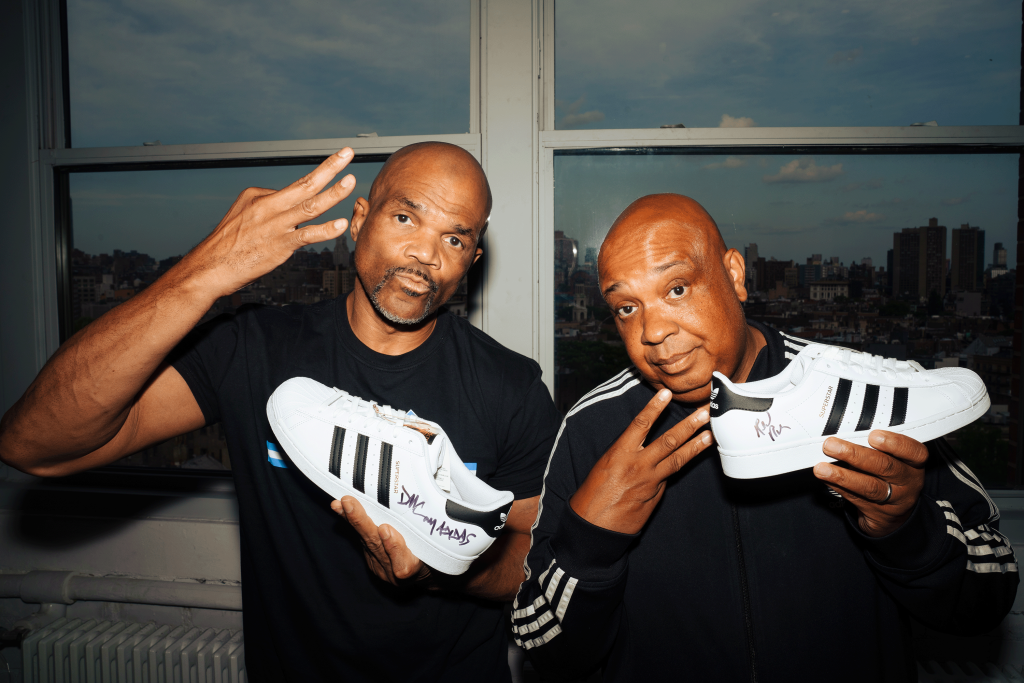
Historic moment in 1986: When the rap group Run-D.M.C. performed at Madison Square Garden, they held up the laceless Superstar and sang the song of the same name, forcing adidas to sign the first hip-hop artist contract in history overnight
The birth of a cultural symbol: The combination of loose shoelaces + gold chains broke the rule that sneakers can only be used for sports
Data confirmation: After the incident, Superstar sales soared 300%, surpassing basketball shoes of the same period for the first time
2. 1990s: The era of the three-stripe “street uniform”
West Coast certification: Dr. Dre wore an adidas Tracksuit on the cover of “The Chronic” album, defining the G-Funk aesthetic standard
East Coast echo: Notorious B.I.G.’s classic look – shell toe + loose striped sweatpants
Design mystery: Why is the Trefoil Logo more popular on the street than the Nike Swoosh? (Hint: Geometric lines that are easy to graffiti)
3. After the millennium: Cross-border hegemony from music to fashion
Kanye’s Yeezy Revolution: How 750 and 350 shoe styles reconstruct hip-hop aesthetics with “ugly fashion”
Data comparison: When Yeezy Boost was released in 2015, the amount of social media discussion was 4.7 times that of Air Jordan in the same period
Underground scene penetration: A new faction of Berlin underground rap groups that uses Gazelle to match overalls
4. Laboratory-level cultural deconstruction
Semiotic analysis: Why the three stripes have more “working-class resonance” than the hook (comparison: Nike hook’s competitive nature vs. adidas stripes’ collective identity)
Material sociology: The friction sound of rubber shell heads and asphalt ground in the 1980s became a natural sampling of early Hip-Hop Beats
5. New battlefield in 2023: Renaissance in the TikTok era
#SambaChallenge: How to go viral among Generation Z with minimalist shoe styles
Star effect 2.0: Bad Why did Bunny’s retro sneaker joint series abandon fluorescent colors and return to the basic off-white style
Latest data: adidas Originals’ brand loyalty among Gen-Z surpasses Nike for the first time (according to Hypebeast 2023 survey)
When Virgil Abloh said “street is dead”, adidas is using the classics in the archives to prove that true cultural dominance never needs to chase trends, but becomes the foundation of the trend itself. The next time you see a rapper subconsciously rolling up his trouser legs to reveal the three-stripe socks, that is the most arrogant victory of this German brand.