In the world of sneakers, technology is not only about foot comfort, but also the soul of brand competition. When it comes to cushioning, Adidas’ Boost and Nike’s Air technologies represent almost two completely different philosophies: one emphasizes softness and energy return, while the other emphasizes support and the tuning of gas pressure.
So, when these two giants clash head-on, whose cushioning technology is superior? This article will re-examine this decade-long “war on foot” from four dimensions: scientific principles, feel, application scenarios, and durability.
I. The Starting Point of Technology: The Story of Popcorn and Air Cushions
The birth of Boost
In 2013, Adidas partnered with German chemical giant BASF to launch a revolutionary midsole material—Boost.
Boost is not a traditional foam, but rather formed by foaming thousands of E-TPU particles under high temperature and pressure. Each particle is like a mini “energy ball,” storing energy when compressed and rebounding when released.
Because its appearance resembles popcorn, it is affectionately known in the sneaker community as the “popcorn midsole.”
This technology caused a sensation in the running world as soon as it was introduced. In 2014, Kenyan runner Dennis Kimetto broke the world record at the Berlin Marathon while wearing Adidas running shoes with a Boost midsole. Since then, Boost has become more than just a material; it has become a symbol of champions.
The Evolution of Air
Compared to Boost, Nike’s Air cushioning is more of a representative of “gas engineering.” Nike first used air cushioning technology in its Tailwind running shoes as early as 1979 , and it has since evolved into several branches:
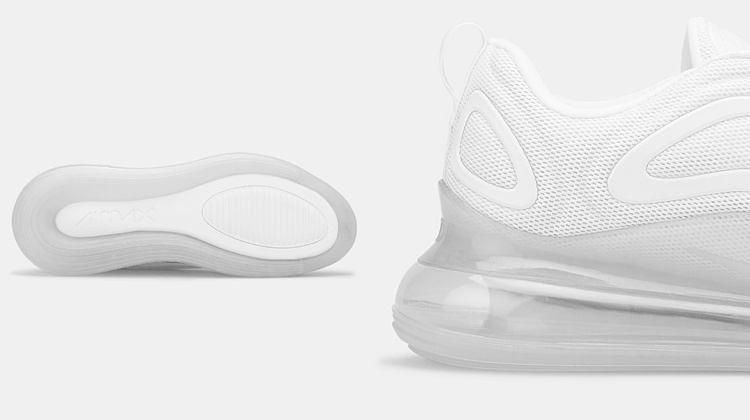
Air Max : The high-pressure air chamber is displayed through a transparent window, creating a strong visual impact.
Air Zoom : By incorporating a dense fiber structure into the gas, faster energy return can be achieved.
Tuned Air / Total Air : Adjusted air pressure to meet the needs of different parts of an athlete’s body.
If Boost is a soft, elastic mattress, then Air is like a precisely tuned shock absorber.
II. The Philosophy of Foot Feel: Softness vs. Elasticity
Boost: Like walking on clouds
When you put on Boost shoes (such as Ultra Boost or NMD), you immediately feel that “melting” softness under your feet.
It effectively absorbs ground impact and provides continuous cushioning, making it ideal for long walks, commutes, or light exercise.
However, some runners feel that it is “too soft” and lacks a clear rebound boundary—like sinking into a sofa, comfortable but not “aggressive” enough.
Air Zoom: The Pleasure of Feedback
In contrast, Air Zoom offers a more “crisp” feel.
Its fiber bundles stretch upon impact and then quickly rebound, providing a strong energy return. Runners can clearly feel the propulsion, especially during fast runs, jumps, or basketball. The
classic Air Max, on the other hand, is more of a “slow-burn” experience—it takes some time to “break in” before it shows its flexibility.
III. Application Scenarios: Ideal Choices for Different Styles
| Use cases | Recommendation technology | Features |
| Daily commute/going out | Boost | Soft and comfortable, gentle on the feet, and relaxing to wear. |
| Running training | Air Zoom | Rapid rebound, high energy return, suitable for sprinting |
| Basketball | Air Max / Zoom | High stability and good support |
| Standing for a long time | Boost | It effectively relieves foot fatigue and has a significant shock absorption effect. |
in other words:
Want to “walk on clouds”? Choose Boost.
If you want to run with a “bouncy” feel, choose Air.
IV. Durability and Controversy: The “Shortcomings” of Both Technologies
Even the most advanced technology has its limitations.
While Boost is comfortable, its foam material is prone to wear and tear and highly absorbent, making it somewhat fragile when worn in the rain or outdoors.
Air cushioning, on the other hand, carries another risk: air chamber rupture . Once the air cushion leaks, the cushioning function is almost completely lost, causing some users to hesitate after intensive use.
Furthermore, the price difference gives a real basis to the joke that “the poor play Nike, the rich play Adidas.” Boost shoes (especially the Yeezy series) often cost thousands of yuan, while Nike’s Air Max or Zoom series have long maintained a high price range.

V. Beyond Technology: A Watershed Moment in Brand Philosophy
Boost’s philosophy is “comfort-centric,” allowing exercise to return to nature and ease;
Air’s spirit is “performance-driven,” pursuing the ultimate balance of speed, responsiveness, and power.
This is not just a difference between two midsole technologies, but also reflects a divergence in brand culture:
Adidas favors a lifestyle that balances functionality and fashion;
Nike remains synonymous with competitive spirit and athletic performance.
In conclusion: The choice of your footing depends on your rhythm.
There is no clear winner between Boost and Air.
They represent two different understandings of “comfort”: the former is gentle and inclusive, while the latter is resilient and decisive.
So next time you stand in front of the shelf and hesitate, you might ask yourself a question—
would you rather walk on clouds or bounce on the ground with every step you take?