——From the NBA hard court to the hip-hop classic, the cross-border deification history
Birth: The beginning of the rubber head
In 1969, adidas launched a pair of shoes originally designed for basketball at its headquarters in Germany – Superstar. It used a very rare full leather upper at the time, with a functional rubber shell toe, the original purpose of which was to prevent basketball players from wearing out their toes when they suddenly stopped and changed direction.
At that time, the basketball shoe market was almost dominated by canvas materials, and the launch of Superstar was extremely radical. It not only provided better protection and durability, but also retained the three-stripe logo in the design and strengthened the ankle position.
In 1970, the NBA began to allow players to wear low-top shoes to play in games, which gave Superstar a great “entry opportunity”. In the following years, it gradually became one of the preferred sneakers for NBA players. According to statistics, by the mid-1970s, more than three-quarters of NBA players wore Superstar to play, and Kareem Abdul-Jabbar was one of the most representative stars among them.
Gods: Run-DMC’s push
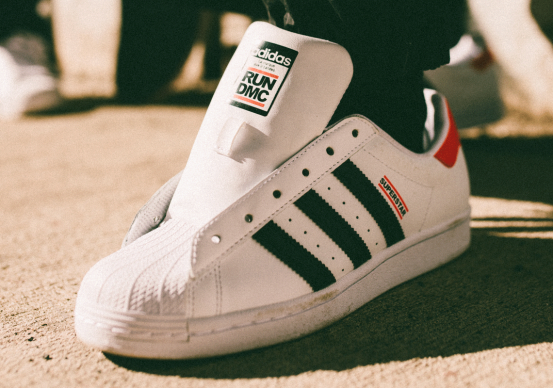
In 1986, the Superstar reached a turning point in its fate. The New York hip-hop group Run-DMC publicly paid tribute to the shoe in the song “My Adidas” and even held up the Superstar during live performances. Wearing it without lacing up became a declaration – a rebellion against mainstream culture and a self-expression of street culture.
Adidas was keenly aware of this wave of cultural power and immediately signed a million-dollar endorsement agreement with Run-DMC. This was the first time that a sports brand signed a contract with a hip-hop musician, and it also opened a new era of linkage between sports brands and pop culture.
Since then, Superstar has become not only a pair of shoes, but also a totem of hip-hop culture. It symbolizes the spirit of the street and has become part of the self-identity of the black community. At that moment, Superstar officially walked from the court to the street, and forever changed the role of sports shoes.
Joint name: cross-border cooperation becomes popular
In the 21st century, Superstar started a frenzy of cross-border cooperation. In 2005, adidas and Japanese fashion brand BAPE jointly launched a camouflage shell toe style, which became one of the hottest styles that collectors competed for. In 2015, Pharrell Williams created the “Supercolor” series, interpreting this shoe in 50 different colors, which is both bold and interesting.
Luxury brands such as Prada and Gucci have also collaborated with adidas to bring minimalist or retro Superstar variants, pushing this sneaker, which originally came from the sports field, to the top of the fashion circle. In 2020, the Superstar celebrated its 50th anniversary, and the brand launched several special editions, including a high-end version with real gold foil details. At the same time, adidas also issued an NFT digital version of the Superstar, some of which were traded at prices exceeding $20,000.
This also indirectly confirms the cultural and market status of Superstar: it is not only a pair of shoes, but also a symbol with collection and commemorative value.
Structure: The reason for its enduring popularity
From an anatomical point of view, the design of Superstar is much deeper than its appearance. The toe adopts a 15-degree naturally upturned shell head structure, which effectively matches the force trajectory of the big toe. The thickness of the tongue padding is maintained at about 5 mm, providing a stable fit, while the midsole uses EVA foam, which is both light and elastic.
What’s more interesting is that from a social psychology perspective, Superstar also has a strong cultural penetration. Its recognition is just right – the three-bar logo is neither too ostentatious nor too prominent. The white style is particularly popular because many consumers agree that “a dirty Superstar has a stronger story.”
In addition, this pair of shoes has a strong cultural universality: you can see it on the street, in the office, at fashion shows and even at high-end parties. Superstar has achieved barrier-free communication among different classes and cultures.
Future: Classics can also evolve
In order to comply with the environmental protection trend, adidas has made a number of sustainable attempts on Superstar. The current version is made of up to 50% recycled materials, and in the future it plans to launch a leather substitute made of mycelium to further reduce the carbon footprint.
At the same time, the brand is also trying to integrate new technologies into classic designs, such as testing smart insoles with built-in foot pressure sensors and exploring rubber materials with self-healing capabilities. Although these technologies are still in the experimental stage, they indicate that Superstar will not only remain in the “retro” role, but also become the carrier of a new generation of technological wearables.
Conclusion: What does Superstar teach us?
If a pair of shoes is popular for one year, it is a trend; if it is popular for ten years, it is a classic. But if it is popular for half a century, it is culture itself.
Adidas Superstar started from the basketball court and has continuously reshaped itself across multiple cultural dimensions such as music, fashion, and the streets. Its success comes not only from its design, but also from the fact that it always carries and responds to the most authentic expressions of people of that era – whether it is power, rebellion, identity, or dreams.
Perhaps in an era of constant technological change, Superstar will continue to exist and move into the next fifty years with that “just right classic”.